Edge And Parapet
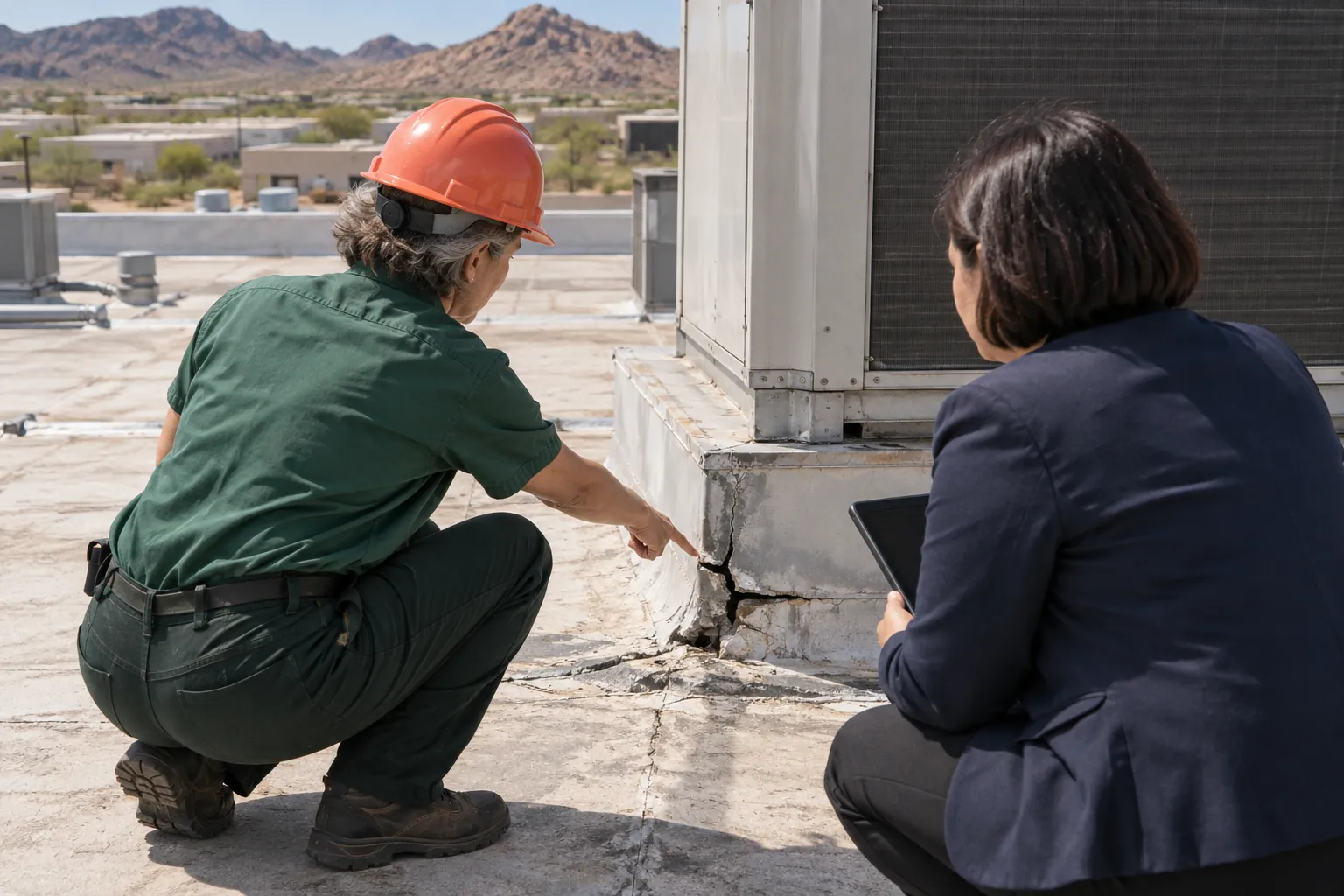
Coping caps crack at their joints and let water run down inside the parapet. Base flashing splits at the inside corner, and termination bars lose caulk, opening a gap behind the membrane.

We repair TPO, built-up, and modified bitumen roofs on Deer Valley warehouses and flex buildings, starting at the seams, drains, curbs, and parapets where flat roofs leak.
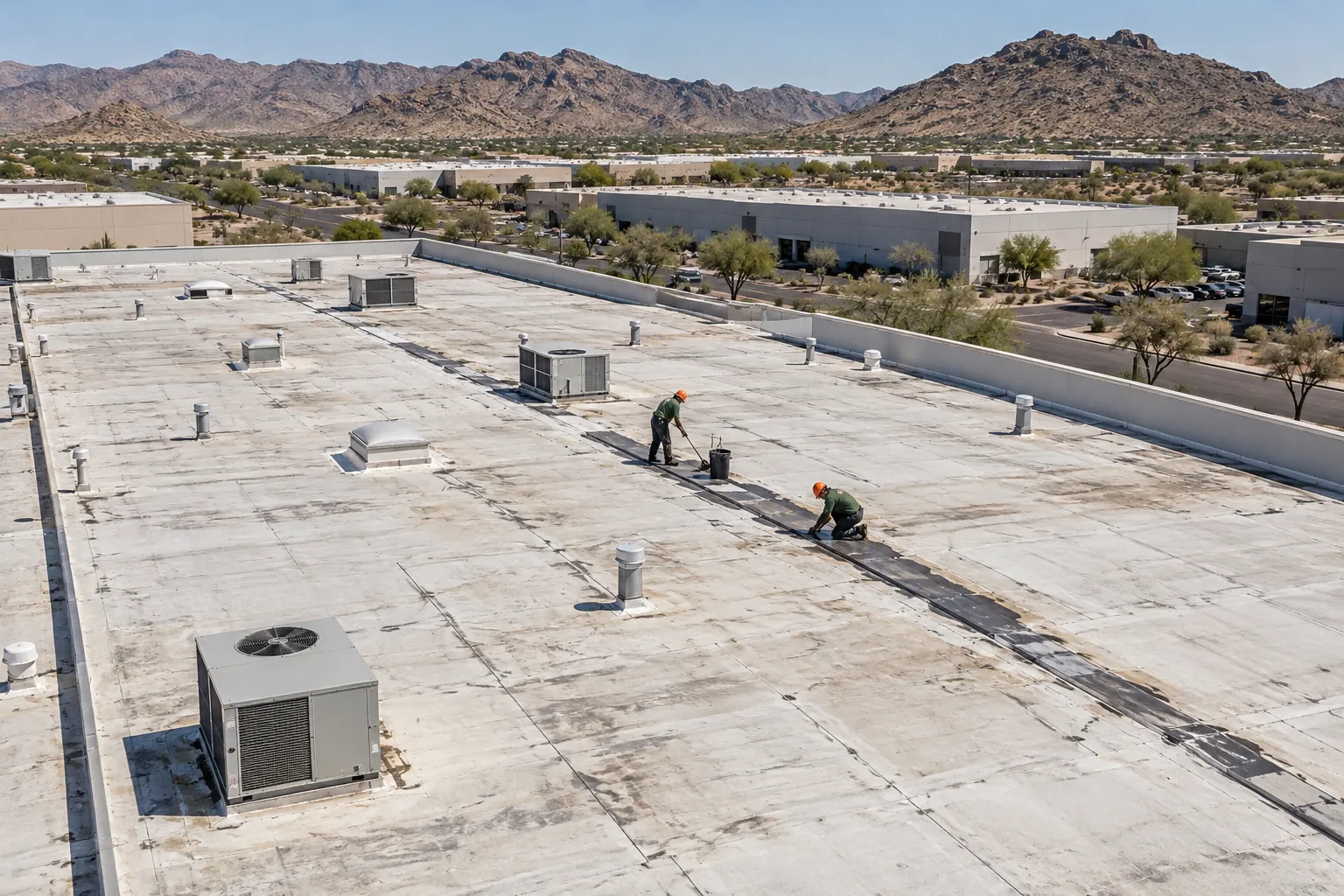
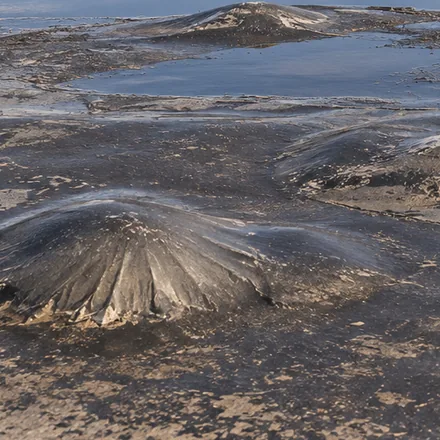
A flat roof repair holds when the damage is local and the layers under it are dry. These are the signs we weigh on the roof.
Five zones of a flat roof account for most of the leaks we trace in Deer Valley. Here is what we look for in each one.
Coping caps crack at their joints and let water run down inside the parapet. Base flashing splits at the inside corner, and termination bars lose caulk, opening a gap behind the membrane.
Heat cycling pulls welded and taped laps apart, starting at T-joints where three sheets meet. A seam probe drawn along each lap catches openings before water reaches the insulation below.
Dust and gravel blown in from the desert pack the strainer and scupper box. Once water backs up, it sits against laps and flashing that were built to shed water, never to hold it.
Rooftop unit curbs, pipe boots, and pitch pans fail where sealant dries out. A pitch pan that has pulled away from a gas line leaves an open ring that drains straight into the deck.
Soft spots underfoot and ponding rings point to wet board. A core cut shows the layers, and wet insulation is cut out so the new membrane bonds to dry material.
Most flat roof repairs fall into four kinds of work. Which one fits depends on how far the water spread under the membrane.
| Repair | What It Stops | When It Is Enough |
|---|---|---|
| Seam weld or re-adhere | Water entering at an opened lap or T-joint | The sheet beside the lap is firm and bonds to new material |
| Cut-out and patch | A blister, puncture, or torn area in the field | Wet insulation stays inside the area being cut out |
| Flashing rebuild | Leaks at curbs, pipe boots, parapets, and pitch pans | The curb or wall behind the flashing is solid |
| Drain and scupper reset | Backed-up water and leaks at the drain bowl | The drain sump still sits level with the roof around it |
Flat roofs cover most of the warehouses and flex buildings around Deer Valley. A repair at the right time pays off differently on each.
Warehouse leaks land on pallets and racking first. Sealing the lap or drain that let water in protects stock without moving a single aisle.
Flex and retail tenants keep their doors open while one seam or curb is repaired. Work happens on the roof, with materials staged away from entrances.
Dry board under the membrane keeps doing its job in the heat. A quick repair stops water from spreading into the next bay of insulation.
Fixing the details that failed first lets the rest of a firm membrane keep working, instead of paying for a full tear-off ahead of time.
Standing water against a seam can turn into a ceiling leak after the next storm. Call us and a roofer can talk through clearing it safely.
Call UsFive steps take a flat roof repair from the first walk to the final water test.
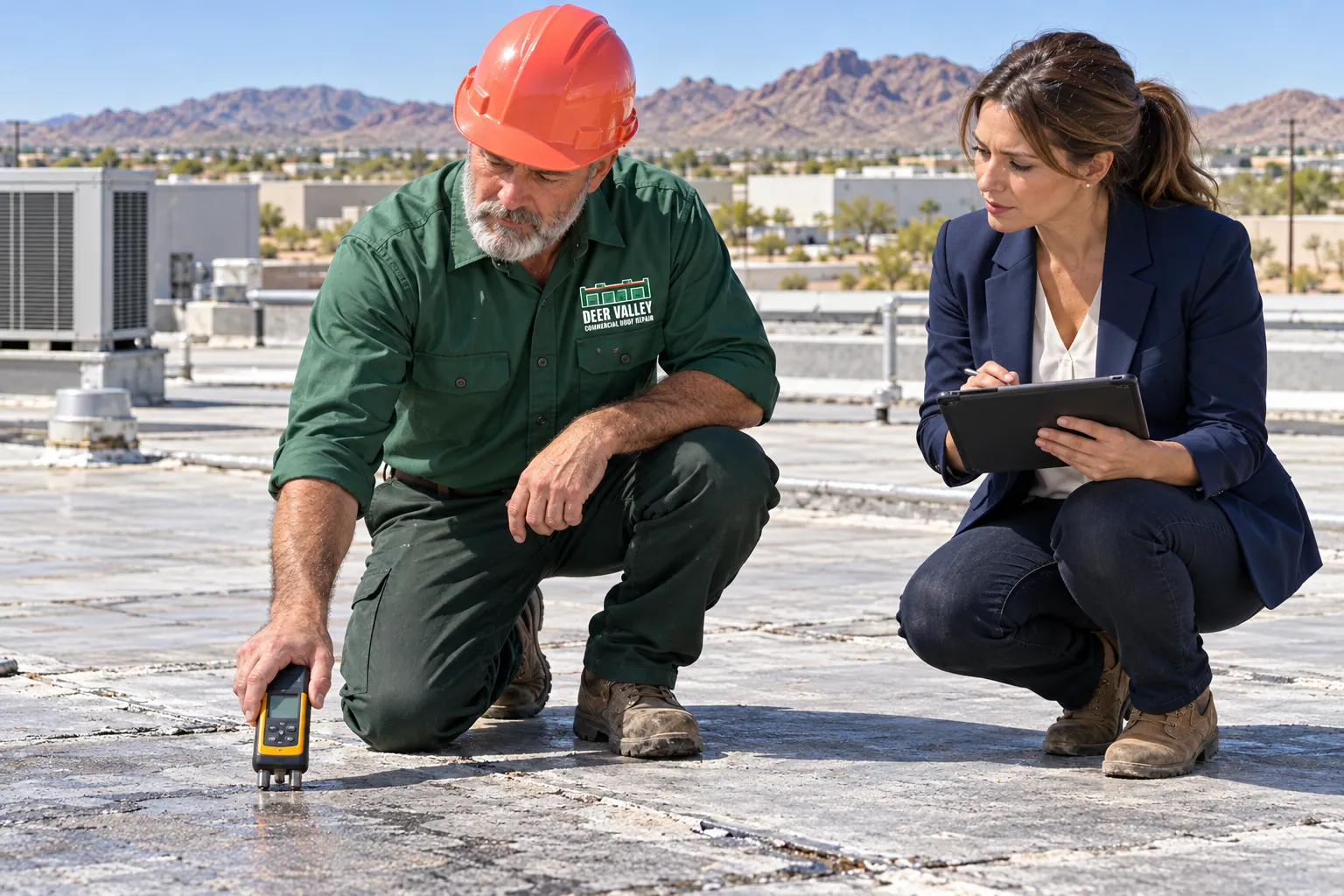
We walk every lap, drain, and curb on the roof and meter the insulation around each stain. That reading shows whether the repair stays small or the wet area has spread.
Water on a flat roof travels along the deck before it drops. Starting uphill of the stain, we check each lap and penetration along the slope toward the nearest drain.
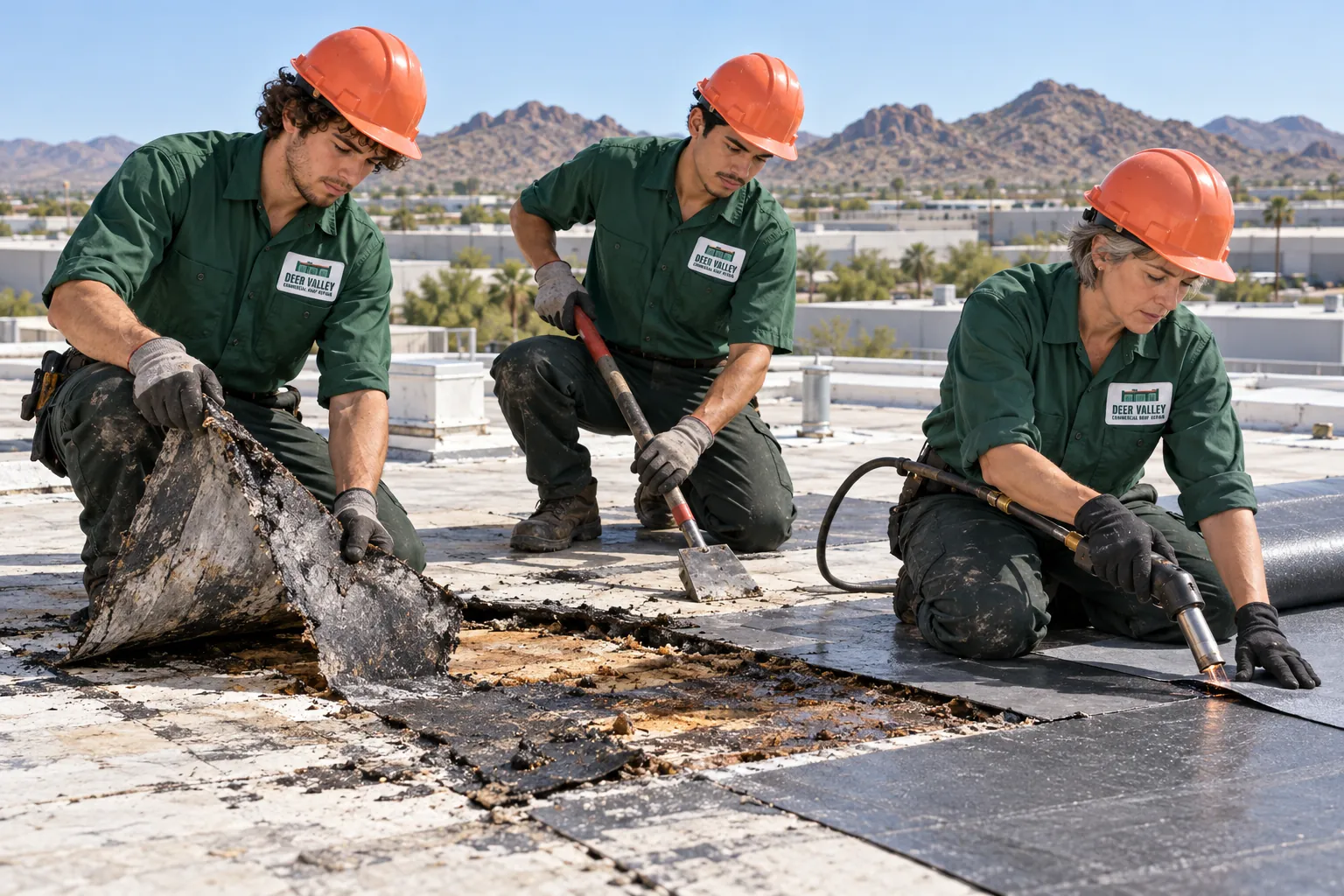
Wet insulation and torn membrane come out down to dry board. The opening is squared up so new insulation and the patch sit flat and bond along every edge.
TPO gets heat-welded, and built-up and modified bitumen roofs get matching plies and cement. Flashing at curbs and parapets is rebuilt with the same system as the field.
Every new weld gets probed, and the repaired area gets a controlled water test where practical. Dated photos record each detail as it was found and as it was left.
Two other services often come up during a flat roof repair.
A ceiling stain far from any obvious damage calls for tracing first. Leak repair follows the water across the deck to the detail that failed.
Trace a leak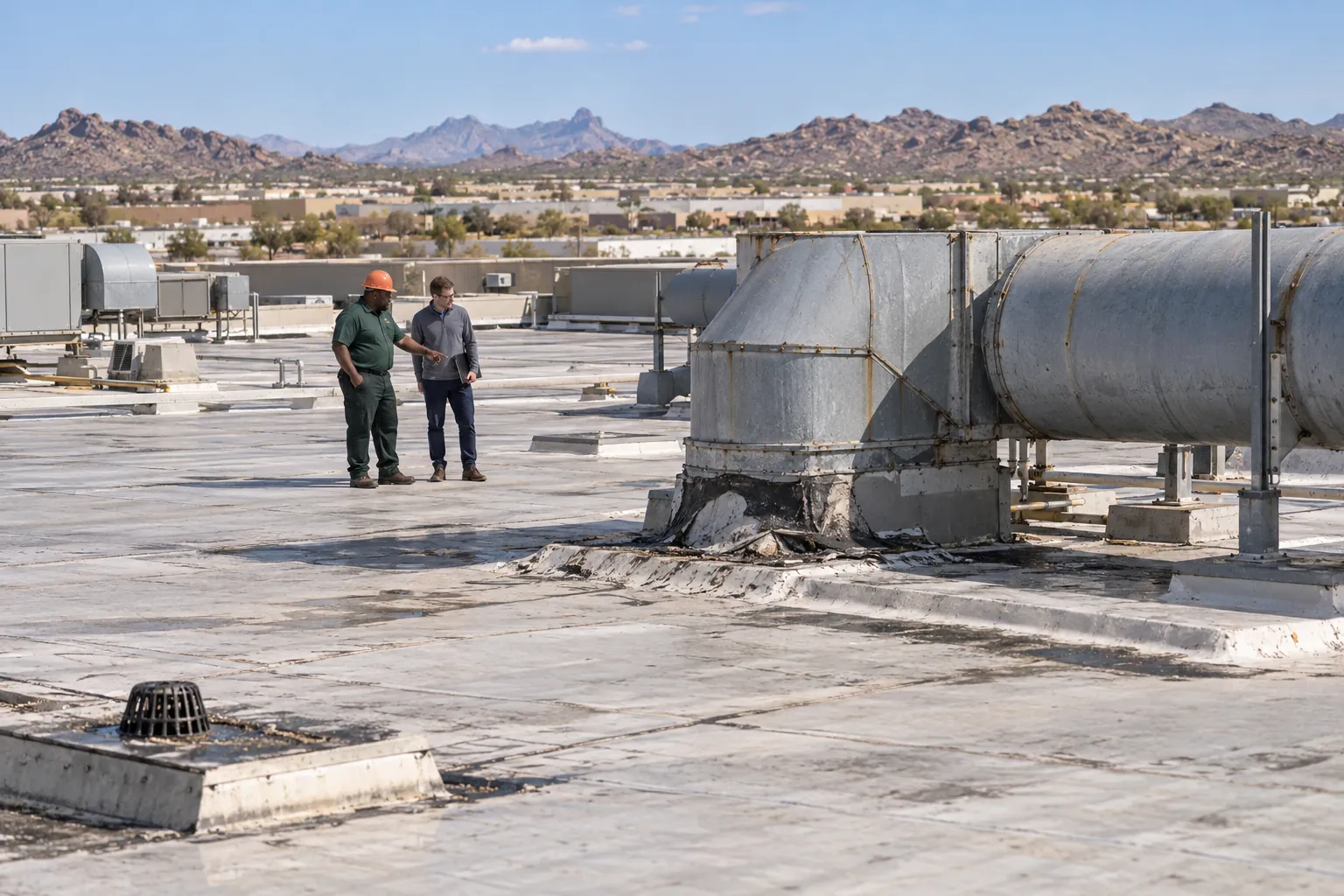
Flat roofs on plants carry ducts, stacks, and walkway pads. Industrial roof repair adds lockouts and work windows around equipment.
Repair a plant roofAt a detail. Opened seams, packed drains and scuppers, loose curb flashing under rooftop units, cracked parapet coping, and dried pitch-pan sealant account for most flat roof leaks on Deer Valley warehouses and flex buildings. The open field of the membrane is rarely the source.
Yes. TPO bonds to TPO with heat, and built-up and modified bitumen roofs take compatible plies and cements. Mixing systems leaves a joint that separates as the roof heats and cools, so we identify the membrane from a core or seam sample first.
Small, firm blisters can be watched. A blister that cracks, grows, or sits in a ponding area gets cut out, dried, and patched, because once its skin breaks, water goes straight into the felts or insulation underneath.
Water that stays more than a couple of days after rain deserves attention. It usually means a blocked drain, a sagging sump, or wet insulation compressing under the membrane. Clearing a drain is quick, while a sag needs the insulation rebuilt to bring the area back up.
Repairs go in early in the day during summer, when the membrane is cooler and adhesives have time to set. The same heat opens seams in the first place, so new laps get probed again on the follow-up check.
The number of leak points, how much wet insulation must come out, the membrane type, and roof access drive the cost. One curb flashing is a small job; several opened seams with wet board underneath is a larger one. We explain the scope after the inspection.
Tell us which seam, drain, or wall is leaking and what system is on the roof. We will set up a free inspection.
Leave a name and number, or call (623) 310-0171 now.